Error-free restaurant menu translation for guests
A guest who doesn't understand the menu rarely orders with confidence. Most often, they choose a familiar dish, ask staff for an explanation, or give up on an item that could bring the restaurant more sales. Therefore, restaurant menu translation isn't a secondary detail for tourists; it's a direct part of service, offer presentation, and the establishment's daily operations.
For restaurants, cafes, bars, and hotels, especially in locations with foreign guests, a good translation eliminates unnecessary questions and reduces the risk of incorrect orders. Guests make decisions faster, staff spend less time explaining, and the offer looks more professional. However, quality translation isn't a literal word-for-word transfer. The menu must remain clear, accurate, and appealing.
Why restaurant menu translation impacts sales
A menu is a sales tool. It should tell the guest what they're getting, how the dish is prepared, and whether it suits their habits, needs, or dietary restrictions. If the translation sounds unclear, too literal, or even funny, trust in the offer declines.
For example, a local dish often doesn't have an exact equivalent in English, German, or another foreign language. The name "Karađorđeva šnicla" shouldn't be translated so that its local identity disappears. It's better to retain the original name and then briefly explain the ingredients and preparation: a breaded meat roll filled with cheese, served with a side dish. The guest then understands what they're ordering, and the dish retains its authenticity.
Good translation also helps with more expensive items. When a guest clearly sees the type of fish, cut of meat, side dish, sauce, or origin of the wine, they are more likely to accept the price. Conversely, descriptions like "house specialty" without a concrete explanation are often not enough for a foreigner sitting in your establishment for the first time.
Literal translation is a common mistake
Automatic translations can serve as an initial draft but are not ready for publication without review. The problem isn't just grammar. The program often fails to recognize culinary context, local expressions, ingredient names, or preparation methods.
The phrase "pileći file" (chicken fillet) can be translated as chicken fillet, which is fine in most cases. But "dimljeni vrat" (smoked pork neck), "urnebes" (spicy cheese spread), "prebranac" (baked beans), "kajmak" (clotted cream), or "roštiljsko meso" (barbecued meat) require additional explanation. If a term is translated incorrectly, the guest might expect an entirely different dish. This leads to complaints, returned food, and uncomfortable communication with staff.
Special care is needed for allergens. The indication that a dish contains nuts, gluten, milk, eggs, shellfish, or alcohol must be precise and consistent in every language. There's no room for creativity or assumptions here. If the recipe changes, the menu description must also change.
Dish name and description don't do the same job
The name should be short and easily noticeable, while the description provides the necessary context. For local specialties, the most practical approach is a combination of the original name and a clear explanation in the guest's language.
Instead of translating "gibanica" with a single word that doesn't convey much, you can present it as: "Gibanica - traditional pie made with thin pastry, cheese, and eggs." This preserves the domestic character of the offer, but the guest isn't left without information. The same principle applies to ajvar, proja (cornbread), homemade sausage, pljeskavica (grilled meat patty), and other dishes with a local identity.
How to organize translation before publishing
The best results come when translation isn't a separate task rushed before the season. First, prepare your basic menu in Serbian. Each item should have an accurate name, ingredient description, weight where relevant, price, and labels for allergens or dietary categories.
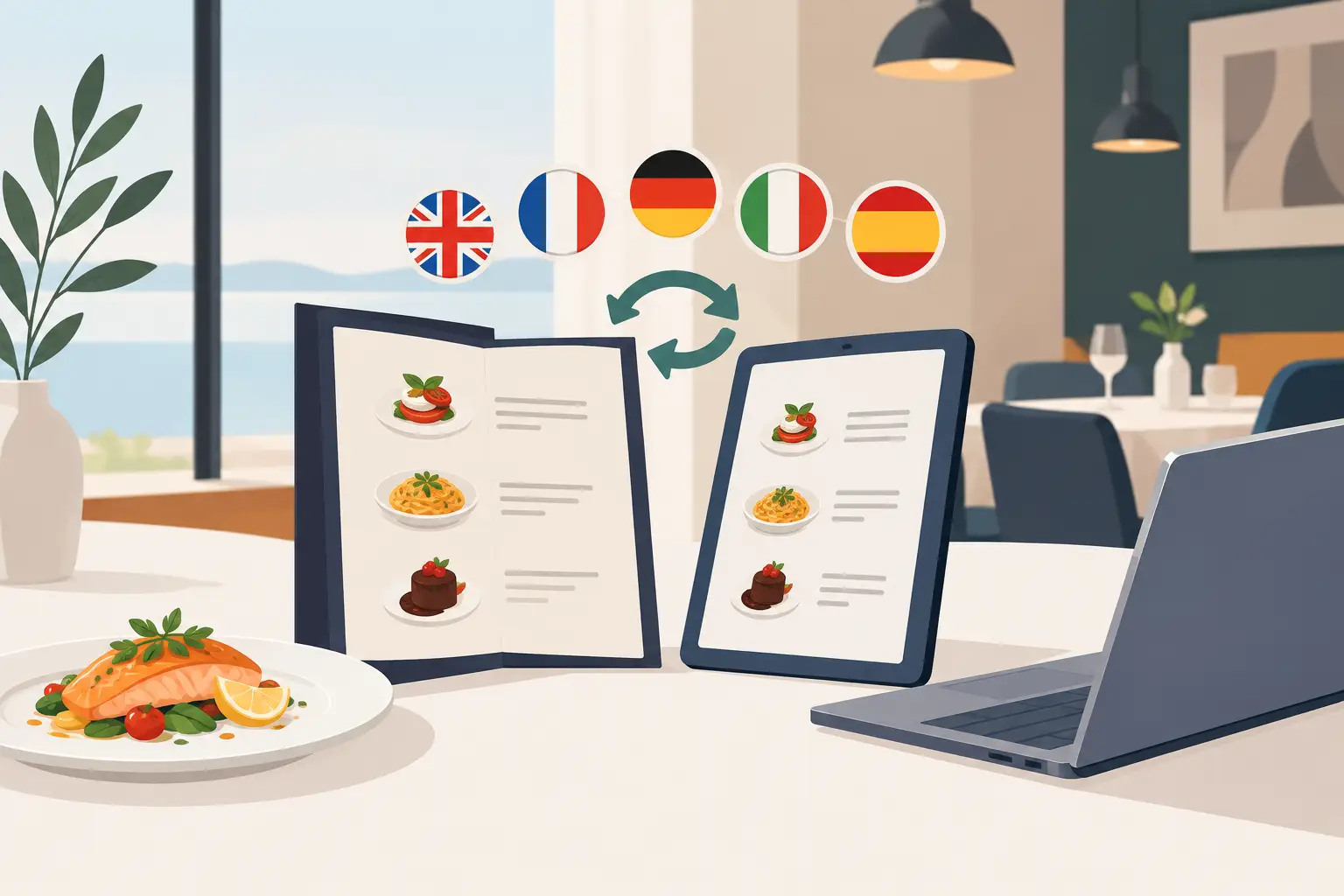
Then, decide which languages your guests actually use. English is the most common choice, but not always the only one. A hotel with many guests from Germany might need a German translation. A seaside establishment might have a different guest structure than a city cafe in Belgrade. You shouldn't translate into five languages just because it looks good – each additional language increases the scope of control and maintenance.
Before publishing, someone familiar with your kitchen should review each item. A translator might be excellent at the language but can't guess whether your "teleći medaljon" (veal medallion) is served in mushroom sauce or with grilled vegetables if it's not clearly written in the source material. The kitchen, manager, and person responsible for the menu should work from the same, up-to-date version of the offer.
For internal review, it's useful to ask four questions:
- Does the guest immediately understand the main ingredients and preparation method?
- Do the name and description match what the kitchen actually serves?
- Are allergen, vegetarian, and vegan labels accurate?
- Are the price, weight, and availability the same across all language versions?
This check takes little time but prevents many problems during a shift.
Digital menu simplifies multilingual offerings
A printed menu is limited as soon as a price changes, an ingredient runs out, or a seasonal dish is introduced. If the menu exists in two or three languages, every change means new file preparation, translation review, and printing costs. In practice, many establishments therefore leave outdated descriptions or manually cross out items, which doesn't leave a good impression.
A digital menu allows translations to be maintained in one place. When you change a price, add a daily special, or temporarily remove a product, the change can be visible immediately. Guests use a QR code to choose the language that suits them, and staff don't have to search for different printed versions around the dining room or terrace.
For seasonal establishments, this is especially practical. Summer drink menus, fish offerings, cocktails, hotel breakfasts, or winter specials can be changed without waiting for new printing. On a platform like menu4.me, it's important that content remains easy to edit, because the speed of change is only valuable if daily use is easy for the team.
Don't just translate text – adapt the guest experience
A foreign guest might not be familiar with local measurements, local names, or common side dishes. If an item includes something that isn't obvious, write it down. "Mešano meso" (mixed grilled meat) can mean different combinations in different restaurants. Clearly state the types of meat and side dishes, rather than expecting the guest to guess.
The same applies to drinks. For rakija (brandy), state the fruit it's made from. For coffee, explain the size or preparation style if it differs from the guest's expectation. For wine, it's more useful to state the variety, origin, and taste profile than to just use a label name that doesn't mean much to a foreign guest.
However, the description shouldn't become too long. A mobile screen requires conciseness. One clear sentence is usually enough: main ingredient, preparation method, and an important addition. If the story behind a dish is important to your concept, add it where it supports the establishment's identity, not under every item.
Translation maintenance is part of regular operations
The most common mistake isn't a bad initial translation, but a translation that remains unchanged while the offer changes. The kitchen replaces a side dish, the bartender changes a cocktail recipe, a supplier brings different cheese, and the foreign description remains the same. Guests then receive information that is no longer accurate.
Designate one person to approve menu changes before publication. This could be the manager, owner, marketing person, or head chef, depending on the size of the establishment. The important thing is to have a clear procedure: a change in recipe or price means checking all language versions on the same day.
A quality restaurant menu translation doesn't have to sound literary. It should be short, natural, and precise, just like good service. When guests understand the offer without additional questions, they choose more easily, order with more confidence, and remember your establishment with a better impression.