QR Menu for Your Seasonal Beach Bar
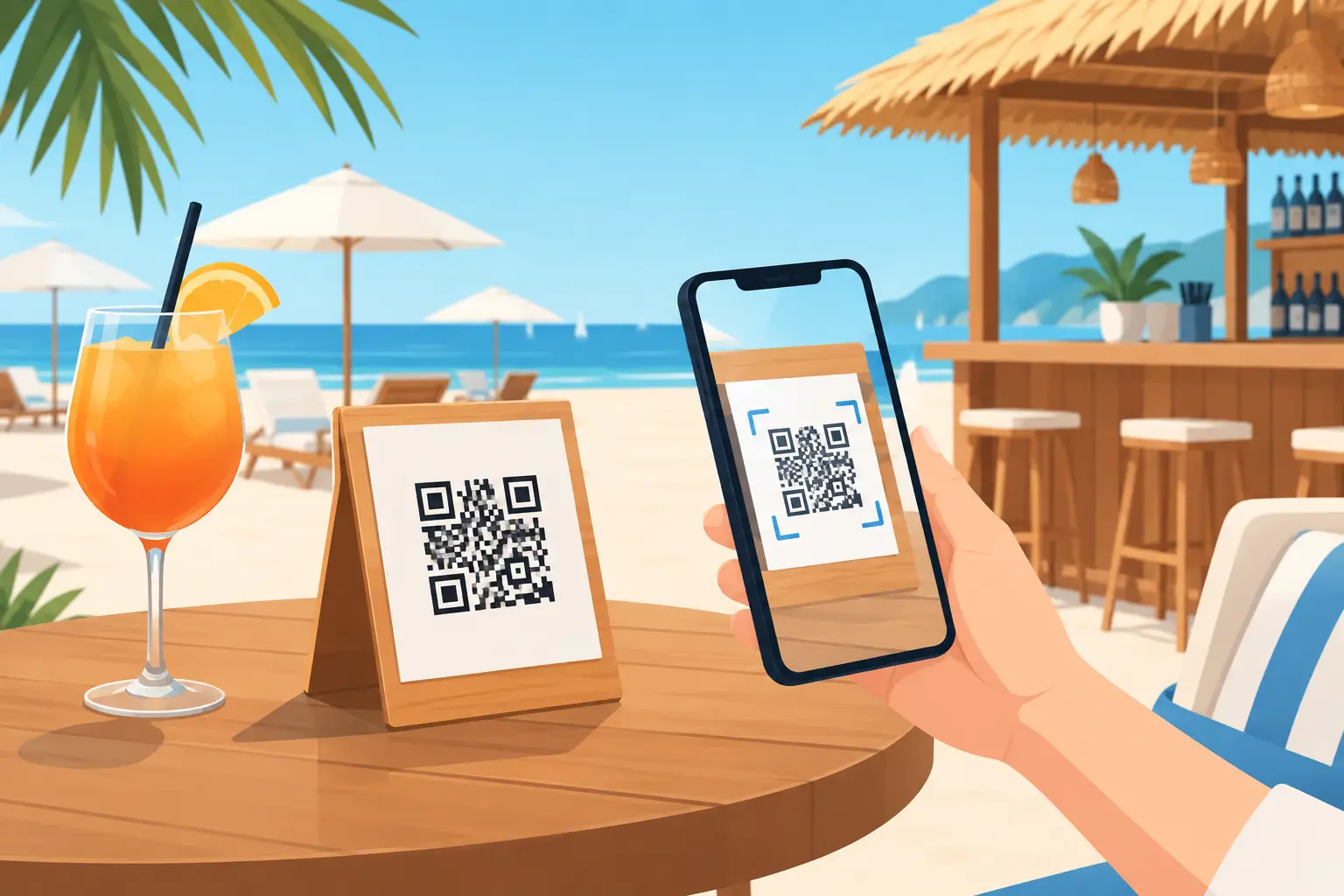
The first row of sunbeds is full, the music is louder than at noon, and the bar receives ten orders in a few minutes. At that moment, a QR menu for a beach bar isn't just decoration; it's a practical part of the service. Guests don't have to wait for a waiter to bring a menu, and staff don't have to repeatedly explain which beer, cocktail, or fresh fish isn't available that day.
A beach bar operates on a different rhythm than a city establishment. Changes are frequent, guests come from multiple countries, sun and water aren't friends with paper menus, and peak season leaves no room for slow administration. A digital menu solves these everyday situations quickly, clearly, and without additional printed versions.
Why a QR Menu is a Practical Solution for Your Beach Bar
On the beach, ordering decisions are often made in a minute. Guests want to see the offer while sitting under a parasol, waiting for friends, or choosing a sunbed. A QR code on the table, bar, parasol, or entrance board leads directly to the menu on their phone. There's no app download, no searching for a waiter, and no flipping through faded, laminated cards.
This doesn't mean a digital menu replaces good service. On the contrary, it gives staff more time for what guests truly remember: a cocktail recommendation, a quick answer about ingredients, and an accurate order. The waiter is no longer just a messenger of basic information that the menu can clearly display, but a person who guides the guest's experience.
For the owner or manager, the key benefit is control. The price of an espresso, a burger add-on, or a premium cocktail can be changed as soon as needed. If a certain juice is sold out, the item is temporarily hidden. If fresh calamari arrive that day or a happy hour offer is active, the information is published immediately. There's no waiting for a designer, printer, or new menu delivery.
Season Demands a Menu That Changes in Minutes
A beach bar rarely has the exact same offering in June and August. In the pre-season, the menu is often shorter, the team smaller, and prices and opening hours are adjusted to calmer traffic. During peak season, the number of items increases, beach packages are introduced, daily cocktails, evening programs, and special offers for groups are added.
A printed menu turns every such change into an expense and a risk. If an old price remains on the table, the guest rightfully expects to pay it. If a waiter has to explain that half the offer is no longer available, it creates an impression of disorganization. With a digital menu, updated information reaches every table simultaneously.
This flexibility is especially useful for procurement. Beach establishments depend on the daily availability of fresh ingredients, ice, fruit, and certain beverage brands. Instead of offering an item you currently can't serve, the menu can reflect the actual availability. This reduces unpleasant conversations, ordering errors, and unnecessary staff burden.
Clear Categories Speed Up Selection
A guest on the beach doesn't want to search for an iced coffee among spirits or open ten pages to find food. A good structure is concise and logical: coffees and soft drinks, beers, wines, cocktails, breakfast, snacks, meals, and desserts. If the establishment offers service on sunbeds, it's useful to clearly mark items that are easy to serve on the beach.
Photos can help, especially for cocktails, platters, and signature specialties. However, don't overdo it. A few high-quality photos sell better than a slow-loading menu that looks like a gallery. The most important elements are the name, price, a brief description, and a clear note about ingredients when necessary.
Multiple Languages Without Multiple Menu Versions
The tourist coast brings together local guests and visitors who don't speak Serbian. A multi-language menu isn't an added luxury but part of clear service. A guest who understands what they're ordering makes decisions more easily, asks fewer basic questions, and has more confidence in the establishment.
Translation shouldn't be literal at all costs. Names of local dishes, rakija, or special cocktails can retain their character, but the description should explain what the guest receives. For food, it's useful to list main ingredients, and for drinks, the quantity or style. This avoids false expectations, especially concerning spicy food, seafood, or strong alcoholic beverages.
For most beach bars, Serbian and English are the starting point. Additional languages make sense where the guest structure justifies it. If the establishment is mainly visited by guests from one region or country, an additional menu version can bring a visible advantage. If there's no such need, it's better to maintain two excellent and accurate language versions than four outdated ones.
How to Position Your QR Menu So Guests Actually Use It
The QR code must be visible where guests naturally look. On the table, sunbed card, bill, counter, and entrance, there can be various access points, but each should lead to the same, updated menu. The code must not be too small, scratched, or placed under a plastic reflection. If a guest has to adjust it in the sun for their phone to recognize it, the experience starts poorly.
Next to the code, place a short and clear message, for example: "Scan for menu." Don't expect every guest to figure out what the code is for on their own. Older guests may still ask for help or a paper version, and that's a perfectly realistic situation. A digital menu should reduce friction, not make the establishment seem inaccessible.
Loading speed is also important. Mobile signal on the beach can be variable, especially during peak season. The menu should therefore be simple, phone-friendly, and without unnecessarily heavy elements. Before launch, test it on different devices, via mobile internet, in the sun, and from the perspective of a guest visiting the establishment for the first time.
A QR Code Is Not a Substitute for Organization
A digital menu solves information display but cannot independently solve a slow bar, an unclear ordering system, or insufficient staff. If a guest sees a cocktail promotion, but the staff doesn't know about it, the effect is counterproductive. Every menu change should be briefly communicated to the team before the start of the shift.
Also, choose carefully what you promote. A discount on an item with low stock can create crowds and disappointment. A daily special makes sense when the kitchen and bar can reliably deliver it. A digital menu provides speed, but a good decision still depends on business judgment.
What a Beach Bar Gains Beyond Printing Savings
Savings on printing are easily measurable but not the only benefit. A digital menu maintains brand consistency. Item names, photos, prices, and descriptions look the same on every table, without worn-out or handwritten cards. This is especially important for bars that want a neat, modern impression and a higher average spend per guest.
The menu is also a space for smart attention-directing. A house specialty, a new cocktail, or a combo for two can get a prominent place without changing the entire menu. Don't push every item to the forefront. A few well-chosen recommendations seem helpful, while too many banners quickly look intrusive.
For the operational team, the advantage is simple: fewer questions about prices and availability, less inconsistent information, and less throwing away old menus. A solution like menu4.me allows an establishment to manage its offering in one place and adapt it to the pace of the day, season, and guests.
Ultimately, the best QR menu for a beach bar doesn't try to be a technological spectacle. It shows the guest exactly what they can order in a few seconds, in a language they understand, while giving the team more time to create an atmosphere that will make the guest return.