Multilingual Restaurant Menus Guide for Owners
A guest who doesn't understand the menu rarely orders with confidence. Most often, they choose a familiar dish, ask staff for an explanation, or give up on an order they would otherwise gladly try. For hospitality businesses, this directly impacts the average bill, service speed, and overall impression of the establishment.
This guide to multilingual menus is intended for restaurants, cafes, bars, and hotels that want to present their offerings clearly to both local and international guests. The goal isn't just to translate dish names. A good multilingual digital menu provides guests with enough information to choose quickly, and allows the team to make changes without new printing costs.
Why Multilingual Menus Affect Sales
On the coast, in larger cities, and in places with significant tourist traffic, foreign guests are not an exception but a part of daily service. If the menu is only in Serbian, the waiter becomes a translator, and ordering takes longer. When information is incomplete, the possibility of incorrect expectations increases – a guest might not know if a dish is spicy, if it contains pork, nuts, or a side dish they don't want.
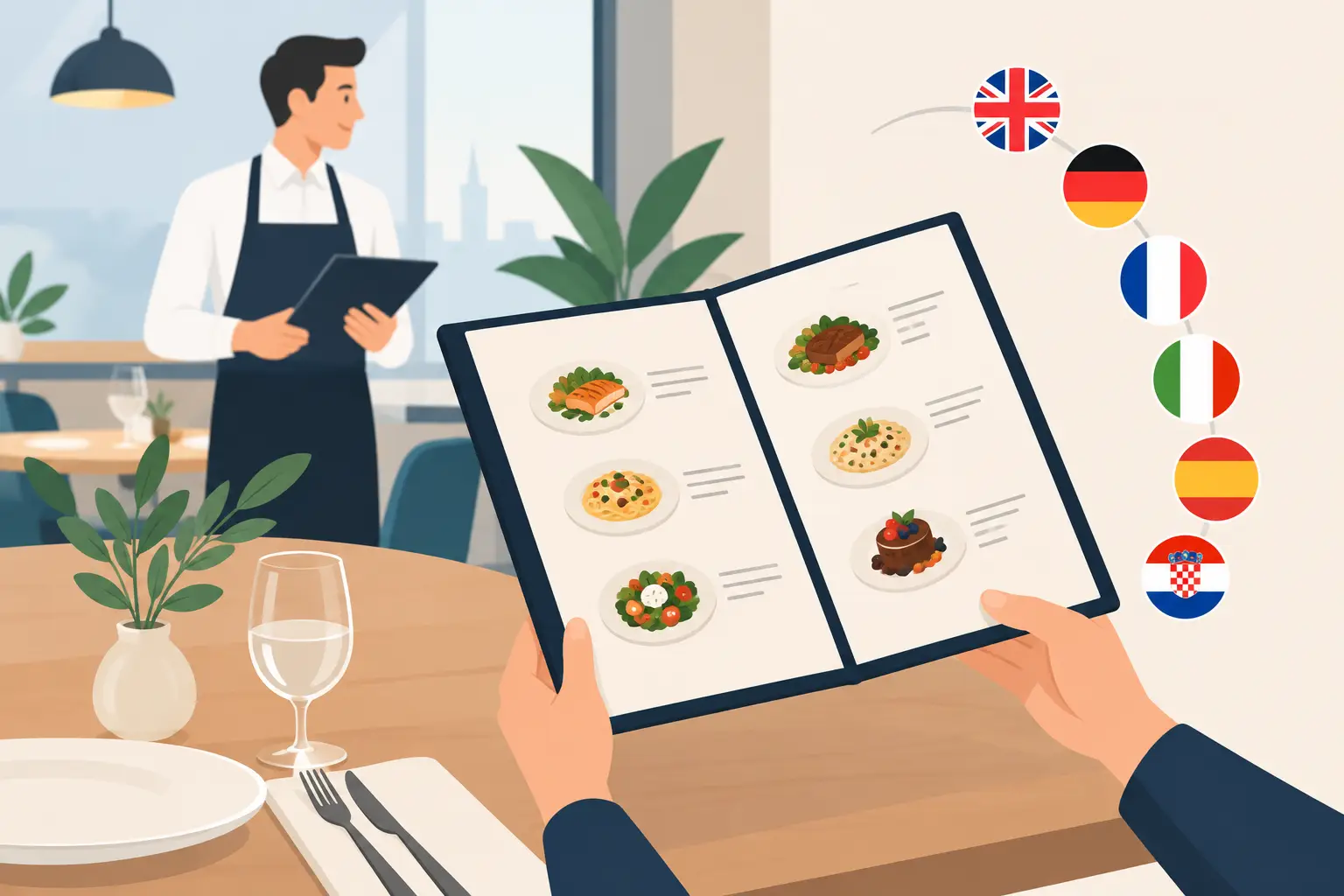
A clear version in the guest's language reduces the number of additional questions, facilitates recommendations, and builds trust. This doesn't mean every establishment needs a menu in ten languages. The number of languages should reflect the actual guest structure, location, and season.
For most hospitality establishments in Serbia, Serbian and English are a good start. Depending on the market, German, Russian, Hungarian, Romanian, French, or Turkish may also make sense. A hotel in Belgrade will have different needs than a restaurant in Zlatibor or a beach bar on the coast. It's important that each added language version is accurate and maintained.
What a Menu Translation Must Include
The biggest mistake is to translate only the dish title. Guests often need a description, ingredients, quantity, allergen labels, spice level, vegetarian or vegan indication, as well as information about side dishes. If a dish is available only during a specific time of day or is currently sold out, that information must also be visible in all active languages.
Sometimes, the name of a dish should not be translated literally. "Karađorđeva šnicla" can remain under its original name, but it needs a short description in English: breaded meat roll filled with kajmak, with a specified side dish. The same applies to ajvar, proja, pljeskavica, prebranac, and other local dishes. The original name preserves the character of the offering, and the explanation removes ambiguity.
For international dishes, the opposite is true. A guest may not need the local name for "Caesar salad," but they need a precise description of the variant you offer. Does the salad contain chicken, bacon, anchovies, Parmesan, and croutons? A short, concrete description prevents complaints and unnecessary questions.
Pay Special Attention to Allergens
Allergens are not decorative icons. They must correspond to the actual recipe and preparation method. If the kitchen changes an ingredient, the change should immediately be reflected in the digital menu. Also, a label stating that a product "may contain traces" is not the same as claiming the dish is gluten-free or nut-free.
A digital menu facilitates regular updating of this data, but the responsibility remains with the establishment. Someone from the kitchen or management should confirm ingredients before publication, especially for seasonal specials and new desserts.
How to Choose Languages Without Unnecessary Work
Don't choose languages based on assumptions, but on data. Look at where reservations come from, which cards guests use, in which languages you receive reviews, and what questions staff hear most often. If 80 percent of foreign guests use English without problems, it might be better to have a perfectly arranged English version than five superficially translated versions.
Seasonality is important. During summer, you can activate additional languages, and out of season, retain basic versions. With a digital solution, a change doesn't mean new print preparation, waiting for delivery, or throwing away old menus. This is especially useful when prices, daily specials, or the availability of fish and meat change frequently.
A good practice is for the user to choose the guest's language themselves, with a visible selection at the top of the page. Do not automatically display a version solely based on phone location. A guest from Serbia might use a phone set to English, and a foreign guest might want original names in Serbian.
Multilingual Digital Menus Must Be Concise and Consistent
A menu is not a tourist brochure. Descriptions should be informative enough, but not too long. Instead of a marketing phrase like "unforgettable explosion of flavors," write what the guest gets: type of meat, key ingredients, preparation method, and side dish.
Consistency is as important as good translation. If you use "grilled chicken" once, don't write "chicken from grill" elsewhere. If quantities are displayed in grams, maintain the same format throughout the offering. If you state that the price is per portion, do not change the label in another category without reason.
Specifically check the following before publishing:
- names of dishes, drinks, and local specialties
- prices, currency, and quantity labels
- ingredients, side dishes, and allergens
- vegetarian, vegan, and spicy options
- item availability and daily promotions
This check seems simple, but it prevents situations where a guest sees one thing on the English version, and the staff or printed price list says another.
Digital Menus Provide More Control Than Print
A printed menu makes sense for establishments that rarely change their offerings and primarily serve local guests. However, as soon as you introduce seasonal dishes, multiple currencies, different language versions, or frequent price corrections, printing becomes slow and expensive.
A digital menu accessible via a QR code solves the operational part of the problem. Guests scan the code and open the offering on their phone, while staff can change a price, hide a sold-out item, or add a new dish without waiting for a new batch of menus. For establishments with multiple locations, it's also a way to standardize names, descriptions, and the visual presentation of the offering.
However, a digital menu is not an excuse for poor content. If the text is small, the translation incomplete, or the navigation unclear, a QR code won't improve the experience. The page must load quickly, be readable on a phone, and offer easy navigation between categories and languages.
menu4.me was created precisely for such daily hospitality needs: to make the offering immediately available to the guest, and changes simple for the team managing the establishment.
Organize the Translation and Update Process
The best results don't come from a one-time translation, but from a clear process. First, prepare the final version of the menu in Serbian. Only when names, recipes, prices, and categories are confirmed, send the content for translation. Translating while the basic version is constantly changing creates duplicate work and inconsistent information across languages.
Then, designate a person responsible for approving content. This could be a manager, owner, head chef, or marketing team, but the responsibility should be clear. When a recipe, price, or availability changes, the same change must be checked across all language versions.
It's useful to maintain an internal glossary of terms. In it, record how you translate local ingredients, types of meat, preparation methods, and common labels. This way, new team members, translators, and managers will use the same language, without improvisation from page to page.
Test the Menu as a Guest
Before placing QR codes on tables, open the digital menu on several different phones. Go through the language selection, find a specific dish, check if prices are legible, and ask someone who doesn't speak Serbian to order based solely on the displayed content. If they have to ask what they're getting, the description isn't good enough yet.
A good multilingual menu doesn't try to say everything. It gives the guest exactly what they need at the right moment to choose with confidence. When translation, information, and updates are under control, staff have more time for service, and guests have more reasons to order with trust.